Alimony Calculator India — Free Maintenance & Child Support Estimator
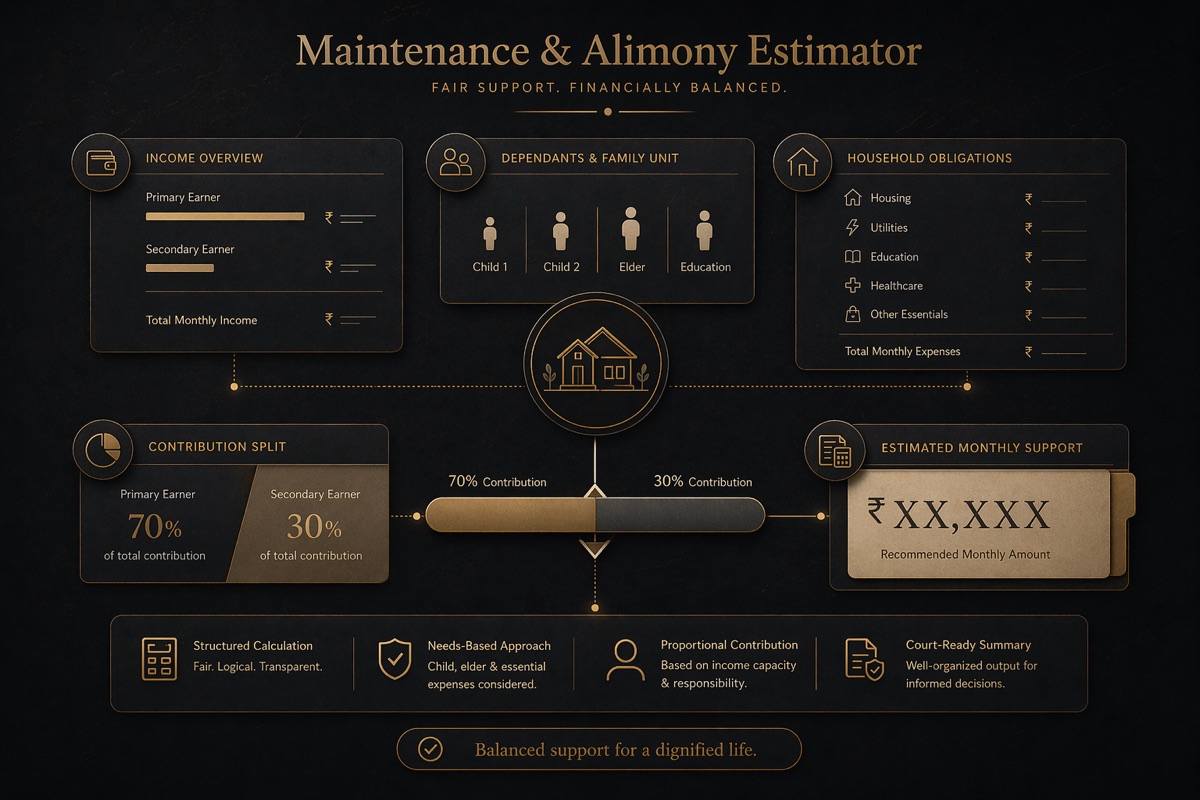
Free alimony estimator and maintenance calculator based on Indian law. Estimate interim maintenance under Section 24 HMA & Section 125 CrPC / 144 BNSS using a Delhi-style maintenance rubric, and model how recurring alimony might be structured over time where parties are negotiating step-ups or inflation protection. Calculating alimony in India accurately requires factoring in both spouses' income, dependants, the marital standard of living and the court's working heuristics — this tool gives you a practical benchmark.
Recurring alimony model: This projection uses a 5% increase every two years as an illustrative planning benchmark drawn from recent case-law discussion. It is not a universal statutory rule and should not be read as a guaranteed court outcome.
How alimony is calculated in India
Indian courts award two distinct kinds of alimony / maintenance: interim (paid month-to-month while a divorce or maintenance proceeding is pending) and permanent (a lump-sum or recurring sum awarded with the final decree). The same court can award both. The legal heads under which alimony is awarded include Section 24 and Section 25 of the Hindu Marriage Act 1955, Section 125 CrPC (now Section 144 BNSS), Section 18 of the Hindu Adoption and Maintenance Act 1956, the Special Marriage Act, the Domestic Violence Act 2005, and the Muslim Women (Protection of Rights on Divorce) Act 1986.
The Delhi High Court "equal-shares" rubric
Delhi maintenance practice often starts with a "family resource cake" heuristic: the household income is treated as a common pool, the earning spouse is often treated as having two shares, and each dependant is treated as having one share, subject to adjustment for custody, school fees, rent, medical needs and admitted liabilities. The estimator above applies that kind of benchmark to a stated income.
A recurring-alimony escalation model
This calculator includes a simple escalation model because recurring maintenance often becomes the subject of later inflation disputes. A 5% biennial step-up is a sensible benchmark for settlement planning and was reflected in the facts of Rakhi Sadhukhan v. Raja Sadhukhan (judgment dated 29 May 2025), but it should be read as a drafting and negotiation aid, not as a mandatory rule that applies automatically to every order.
Frequently asked questions about alimony & maintenance
What is alimony in India?
Alimony is the financial support paid by one spouse to the other after separation or divorce. In Indian law the word "alimony" is used interchangeably with "spousal maintenance". Interim alimony is paid pendente lite — while the proceedings are running. Permanent alimony is awarded with the final decree, either as a lump-sum or as recurring monthly maintenance.
How is alimony calculated in India?
Courts use a multi-factor test — earning capacity of both spouses, the standard of living during marriage, dependants, length of marriage, age, health, conduct, and assets. There is no statutory formula, but Indian benches increasingly use proxies such as the Delhi HC equal-shares rubric for interim orders and the Supreme Court's eight Rajnesh v. Neha factors for permanent alimony.
Is alimony the same as spousal maintenance?
Yes — in Indian usage they refer to the same thing: financial support owed by one spouse to the other. "Alimony" is the colloquial term; "maintenance" is the term used in the statutes (Section 24 HMA, Section 125 CrPC / Section 144 BNSS, Section 18 HAMA, etc.).
Can a wife claim alimony in a mutual consent divorce?
Yes. Alimony in a mutual consent divorce is negotiated between the spouses and recorded in the consent terms / settlement deed filed with the joint petition. Courts confirm the figure if it is fair and freely agreed. There is no compulsion that alimony be paid in mutual consent divorce — the parties can agree that no alimony is payable, but that should be a clean, informed waiver.
Can a husband claim maintenance / alimony from his wife?
Yes. Section 24 HMA is gender-neutral and a non-earning or lower-earning husband can seek interim maintenance from a higher-earning wife. Permanent alimony under Section 25 HMA is similarly gender-neutral. Section 125 CrPC, however, allows only a wife (and parents/children) to claim maintenance — not a husband.
What is alimony pendente lite?
Alimony pendente lite is interim maintenance awarded by the court while the divorce or maintenance proceeding is pending. It is decided early — often within the first 60 days of filing — and is meant to keep the dependant spouse afloat during litigation.
Is alimony taxable in India?
A lump-sum permanent alimony is generally treated as a capital receipt and not taxable. Monthly maintenance is treated as a revenue receipt and is taxable in the recipient's hands. The position has been reaffirmed by several High Court rulings — but always confirm with a tax advisor for your specific situation.
What is permanent alimony in Indian law?
Permanent alimony is the final-decree maintenance — either a lump sum or an indefinite monthly payment — awarded under Section 25 HMA / Section 37 SMA / Section 144 BNSS. Whether that monthly figure rises over time depends on the wording of the settlement or order, and in some cases on a later enhancement application grounded in changed circumstances.
For practical guidance on how a court is likely to apply these principles to your facts, see the guide on Section 125 CrPC / Section 144 BNSS maintenance and the grounds for divorce in India. To start a matter, use the mutual consent divorce intake or contact directly.
May 2026 update: using the estimate in settlement talks
The maintenance calculator is a planning tool, not a court order. Use it to frame a realistic negotiation range before mutual consent divorce, interim maintenance, or settlement drafting. The actual figure can move because of rent, school fees, medical expenses, concealed income, lifestyle evidence, existing liabilities and the earning capacity of each spouse.
For a full legal explanation, read the 2026 guide on how to calculate alimony in India and the companion article on alimony in mutual consent divorce. If settlement terms are being drafted, convert the estimate into a clear monthly or lump-sum clause with due dates, tax treatment and default consequences.