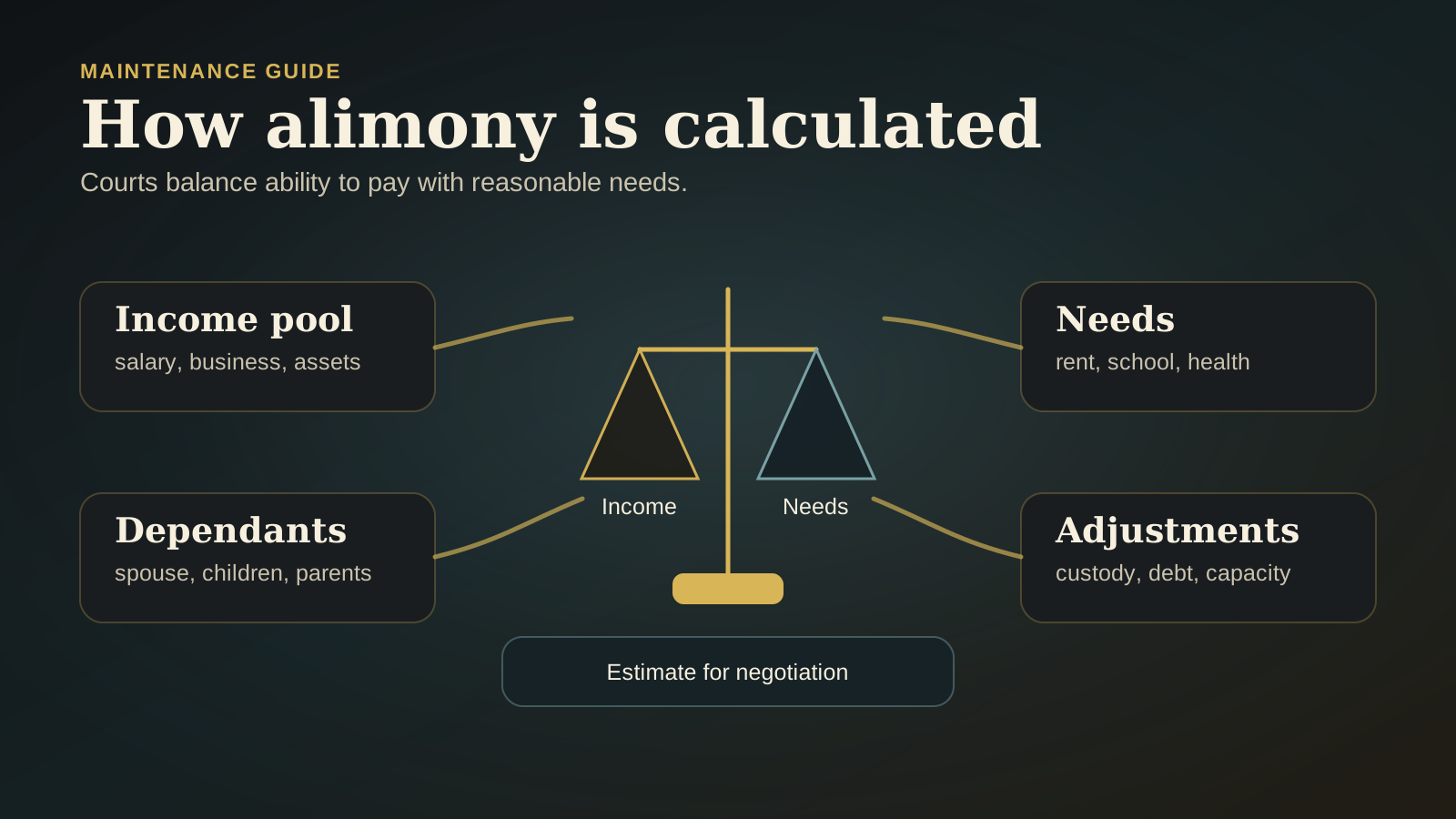
There is no fixed alimony formula in India. Courts decide the amount case by case under the Rajnesh v. Neha (2021) framework, weighing both spouses' income and assets, the standard of living during the marriage, child responsibilities, and each party's needs. A frequently cited starting benchmark for interim maintenance is around 25% of the paying spouse's net monthly income — but it is a guideline, not a binding rule.
Alimony in India — also called spousal maintenance — is the financial support owed by one spouse to the other when a marriage breaks down. Indian courts award it under several statutes: Section 24 and Section 25 of the Hindu Marriage Act 1955, Section 125 CrPC (now Section 144 BNSS), Section 18 of the Hindu Adoption and Maintenance Act 1956, the Special Marriage Act, the Domestic Violence Act 2005, and the Muslim Women (Protection of Rights on Divorce) Act 1986. This guide walks through how alimony is calculated in India in 2026: the evidence courts expect, the framework in Rajnesh v. Neha, the working heuristics often used in Delhi, and how recent appellate decisions can be used as negotiation benchmarks rather than mechanical formulas.
If you want to skip ahead and see numbers based on your situation, the free alimony & maintenance calculator applies these rubrics to a stated income and gives a defensible estimate.
Two kinds of alimony: interim and permanent
Indian law treats alimony as falling into two distinct buckets:
- Interim maintenance / alimony pendente lite — paid month-to-month while the divorce or maintenance proceeding is pending. Awarded under Section 24 HMA, Section 36 SMA, Section 125 CrPC / Section 144 BNSS, Section 23 of the Domestic Violence Act, or Section 18 HAMA depending on the personal law and the forum.
- Permanent alimony — the final-decree maintenance, awarded with the divorce decree under Section 25 HMA, Section 37 SMA, or as a lump-sum or recurring sum in any maintenance proceeding. Permanent alimony can be lump-sum, indefinite monthly, or a hybrid.
The same court can award both — interim while the case runs, permanent on the conclusion. The figures often differ; permanent alimony reflects a settled view of standard of living and earning capacity over time.
The Rajnesh v. Neha factors — the Supreme Court's framework
In Rajnesh v. Neha (2020), the Supreme Court issued comprehensive directions on the assessment of maintenance. The Court identified eight categories of factors that every maintenance order must consider:
- The status of the parties — economic and social.
- The reasonable wants of the claimant spouse and any dependent children.
- The independent income and property of the claimant.
- The number of persons to be maintained out of the husband's income, including his own dependants.
- The liabilities of the husband.
- The provisions for food, clothing, shelter, education, medical care and similar expenses appropriate to the marital standard of living.
- Payment capacity of the husband, keeping in mind his actual income, ability to earn, and assets.
- Permissible deductions from the husband's income — taxes, statutory deductions, EMIs on subsisting loans for marital use.
The Court also directed that both parties file an Affidavit of Disclosure of Assets and Liabilities at the beginning of the proceeding. This affidavit — annexed to Rajnesh as a model format — is now standard across maintenance proceedings nationwide and substantially reduces the room for income suppression.
The Delhi High Court equal-shares rubric
For interim maintenance, Delhi courts often use a rough “family resource cake” or “equal shares” heuristic as a starting point, while still applying the fuller Rajnesh analysis. The version most practitioners work with is closer to this:
- Treat the household income as a common pool.
- Give the earning spouse two shares and each dependant one share.
- Adjust for actual custody, school fees, rent, health costs and admitted liabilities.
- Use the result as an interim benchmark, not as a statutory entitlement.
The heuristic does not displace the Rajnesh multi-factor analysis. It is simply a defensible starting point that the court adjusts up or down based on evidence. The maintenance calculator on this site uses a similar benchmarking approach so readers can see a plausible range before a real pleading is drafted.
Using Rakhi Sadhukhan carefully
Recent maintenance writing sometimes overstates Rakhi Sadhukhan v. Raja Sadhukhan (judgment dated 29 May 2025). The safer reading is narrower. The Supreme Court upheld, on the facts of that case, an alimony structure with a 5 per cent step-up every two years. That makes the decision useful as a negotiation and planning benchmark where parties are debating inflation protection in a recurring payment. It does not mean every permanent alimony order in India now rises automatically by a universal formula.
If a spouse wants future escalation built into a settlement or order, the better practice is to say so expressly: link the step-up to time, schooling costs, inflation or a review trigger. Where there is no such clause, enhancement usually requires a fresh application based on change in circumstances, including under Section 25(2) HMA where applicable.
Income disclosure: the foundation of every alimony calculation
The accuracy of an alimony order depends entirely on the accuracy of income disclosure. The Rajnesh Affidavit of Disclosure forces both parties to disclose:
- Salary slips for the last 12 months, ITRs for three years, Form 16, and bank statements for one year.
- All immovable property — owned, jointly owned or under HUF.
- All movable assets — vehicles, jewellery, demat holdings, mutual funds, FDRs.
- Liabilities — EMIs, loans, business obligations.
- Monthly expenses — household, school fees, medical, lifestyle.
- Lifestyle indicators — club memberships, foreign travel, credit card spend.
Where a spouse is self-employed or a business owner, the affidavit is supplemented by company records, GST returns, and (where contested) forensic accountant input. The court increasingly draws adverse inferences against parties who file incomplete or contradictory disclosures.
Section 125 CrPC / Section 144 BNSS maintenance
Section 125 of the CrPC — now reproduced as Section 144 of the BNSS following the 2024 transition — is the secular maintenance provision. Any wife, child or parent unable to maintain themselves can claim maintenance from a person of sufficient means. The Magistrate determines the figure on the same multi-factor basis. Section 125 applies regardless of religion, but it is most often used in addition to or instead of Section 24 HMA where the parties are not formally divorced or where the wife wants the speed of a Magistrate's procedure.
Permanent alimony in mutual consent divorce
In a Section 13B HMA mutual consent divorce, alimony is negotiated between the spouses and recorded in the consent terms / settlement deed filed with the joint petition. There is no statutory minimum or maximum. The court confirms the figure if it appears fair and freely agreed and the parties have full understanding of what they are giving up. Lump-sum permanent alimony in MCD is common because it cleanly closes the financial relationship — see our companion article on alimony in mutual consent divorce for the negotiation framework.
Tax treatment of alimony
The accepted position in Indian tax law:
- Lump-sum permanent alimony — treated as a capital receipt and not taxable in the recipient's hands. Several High Courts including Bombay (Princess Maheshwari Devi v. CIT) and Delhi have confirmed this.
- Recurring monthly maintenance — treated as a revenue receipt, taxable in the recipient's hands. The payor cannot claim a deduction.
This asymmetry frequently shapes negotiation in mutual consent divorces — a single lump sum is more tax-efficient than the same total amount paid as monthly maintenance over several years.
What the maintenance calculator on this site does
The free maintenance & alimony estimator applies a Delhi-style interim-maintenance benchmark and also lets you model a recurring-alimony escalation scenario. That projection should be read as a planning tool, not as a statement that every court will grant the same step-up.
The calculator is an estimator, not a binding figure. Real orders depend on evidence, conduct, the specific Bench, and the lawyering. For a position-paper estimate calibrated to your facts and your jurisdiction, share a brief description of the marriage, both spouses' financial positions, and any pending proceeding.
Frequently asked questions
How is alimony calculated in India?
Indian courts apply a multi-factor test combining income of both spouses, the standard of living during marriage, dependants, length of marriage, age, health, conduct and assets. Interim maintenance is increasingly assessed using the Delhi High Court equal-shares rubric — the household income is treated as a common pool and divided so the dependant spouse and children share roughly equal financial standing. Permanent alimony follows the eight-factor framework set out by the Supreme Court in Rajnesh v. Neha (2020).
Is there a fixed alimony formula in Indian law?
No. Indian statutes — Section 24 and 25 HMA, Section 125 CrPC / 144 BNSS, Section 18 HAMA — leave the quantum to judicial discretion. Courts use proxies (the equal-shares rubric, the 25 to 33 per cent of net income range, the Rajnesh factors) but no statutory formula exists. The free maintenance calculator on this site applies the most common rubrics so you get a defensible estimate.
What is alimony pendente lite?
Alimony pendente lite is interim maintenance awarded under Section 24 HMA (or the equivalent in other personal laws) while a divorce or maintenance proceeding is pending. The Supreme Court in Rajnesh v. Neha required courts to dispose of pendente lite applications within 60 days where possible. The standard is a defensible income disclosure from each side and a calibrated award meant to keep the dependant spouse afloat during litigation.
How does the Rakhi Sadhukhan judgment affect permanent alimony planning?
In Rakhi Sadhukhan v. Raja Sadhukhan (judgment dated 29 May 2025), the Supreme Court sustained an alimony structure that stepped up by 5 per cent every two years on the facts of that case. It is a useful planning benchmark, but not a universal statutory rule that applies automatically to every maintenance order.
Can a husband claim alimony from his wife?
Yes — Section 24 HMA and Section 25 HMA are gender-neutral. A husband who is non-earning, lower-earning or unable to maintain himself can seek interim and permanent alimony from a higher-earning wife. Section 125 CrPC, however, allows only the wife (and parents/children) to claim maintenance — not a husband.
Is alimony taxable in India?
A lump-sum permanent alimony is generally treated as a capital receipt and not taxable. Recurring monthly maintenance is treated as a revenue receipt and is taxable in the recipient's hands. The position has been reaffirmed in several High Court rulings; consult a tax advisor for your specific facts.
How much alimony can a wife claim in India?
There is no fixed cap. The wife is entitled to a sum that maintains her at a standard reasonably comparable to the marital standard of living, having regard to the husband's income, her own income or earning capacity, dependants and other factors. Courts commonly award between 25 per cent and 33 per cent of the husband's net income as monthly interim maintenance, but lump-sum permanent alimony orders can be substantially higher.
Need a calibrated alimony estimate?
Share a brief description of the marriage, the financial position of both spouses and any pending proceeding for a position-paper estimate calibrated to the Bench, the jurisdiction, and the facts.
Consultation & feesEstimates are a starting point, not an entitlement — see how a maintenance and alimony lawyer in Delhi argues quantum before Delhi family courts.