Indian law does not recognise "medical malpractice" as a category — what it recognises is medical negligence, and there are three separate routes: a consumer complaint, a civil suit for damages, and a criminal prosecution. The consumer forum is the most commonly used because it is faster and cheaper. Whichever route is chosen, the claim turns on duty, breach, causation and injury — dissatisfaction with the outcome is not negligence, and the standard applied is that of a reasonably competent practitioner in the field.
Scope and jurisdiction at a glance
- Three separate routes
- Indian law does not recognise "medical malpractice" as a category. A claim in medical negligence can be pursued through:
- A consumer complaint, where the patient paid for the service — the most commonly used route because it is faster and cheaper.
- A civil suit for damages, which has no pecuniary ceiling but is slower and carries ad valorem court fee.
- A criminal prosecution for causing death by a rash or negligent act, which requires a markedly higher degree of negligence.
- A complaint to the State Medical Council or the National Medical Commission, which addresses professional misconduct and registration rather than compensation.
- Which consumer commission
- By the value of the consideration paid: the District Commission up to ₹50 lakh, the State Commission above ₹50 lakh and up to ₹2 crore, and the National Commission above ₹2 crore, under the Consumer Protection (Jurisdiction) Rules 2021.
- Where a consumer complaint can be filed
- Where the opposite party resides or carries on business, where the cause of action arose, or where the complainant resides or personally works for gain, under Section 34(2) of the Consumer Protection Act 2019.
- Time limit
- A consumer complaint must be filed within two years of the cause of action, with power in the commission to condone delay on sufficient cause. A civil suit for damages for negligence is ordinarily subject to a three-year limitation.
- The standard applied
- The test is that of the ordinary competent practitioner exercising ordinary skill in that field — the Bolam standard, adopted in India and applied in Jacob Mathew v. State of Punjab (2005). A doctor is not negligent merely because the outcome was poor, or because another practitioner would have chosen a different course.
- What has to be proved
- Duty of care, breach of that duty, a causal link between the breach and the injury, and damage. Causation is where most claims fail, because a poor outcome must be shown to flow from the breach rather than from the underlying condition.
- Evidence that matters
- The complete medical record, consent forms, prescriptions and drug charts, investigation reports, the discharge summary, billing records, and an expert opinion. Obtain the records early — a request for records is itself a documented step.
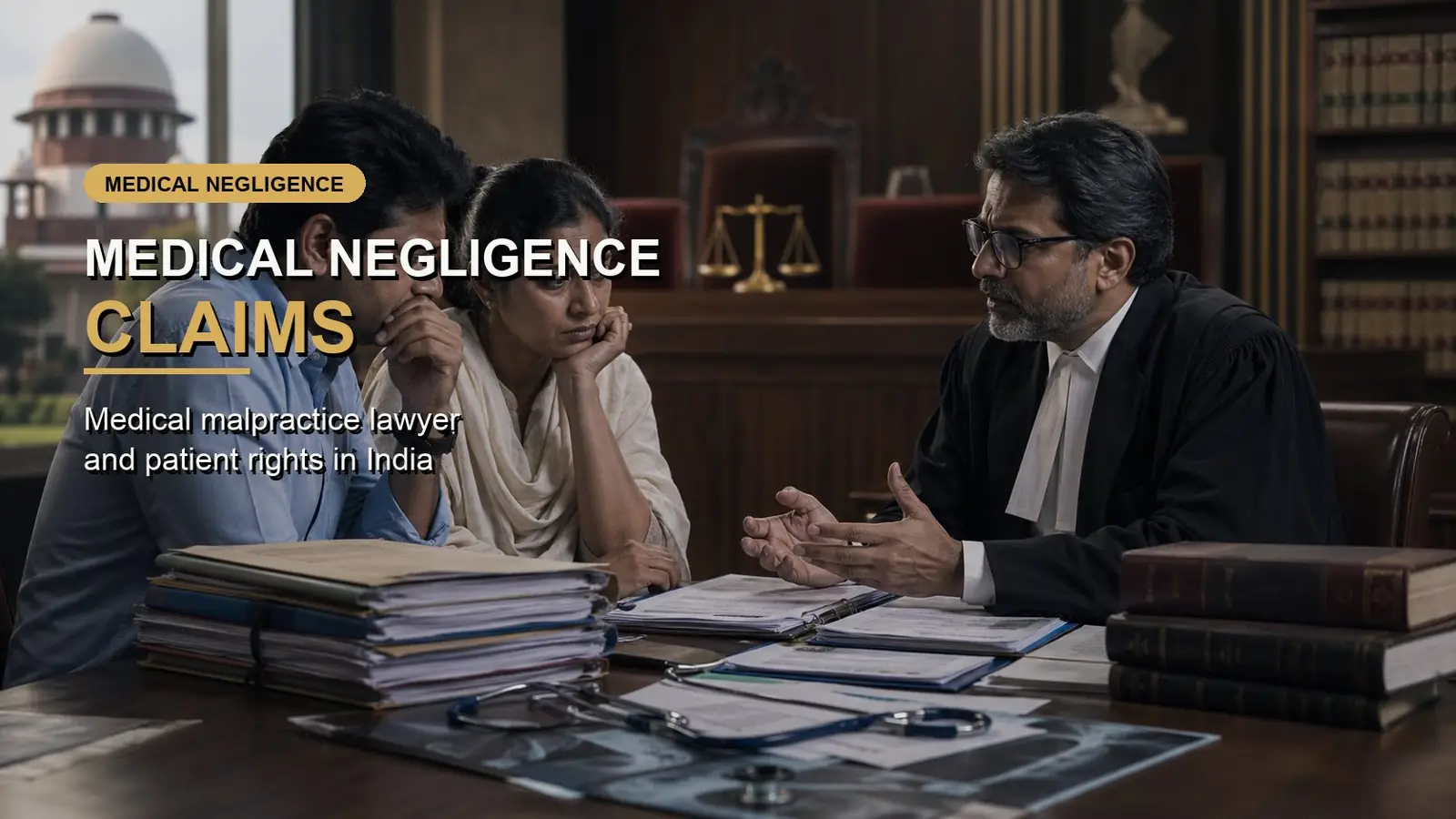
"Medical malpractice" is an American term that has crossed into Indian search habits because of US television and news coverage of large jury verdicts. India does not recognise "medical malpractice" as a category of action. What Indian law recognises is medical negligence — and a claim for medical negligence can be pursued through three different forums depending on what the claimant wants: compensation, professional discipline, or criminal prosecution.
Choosing the wrong forum is the most common and most expensive mistake. This article explains the three options.
Option 1: Consumer forum (the most common route)
Since the Supreme Court's decision in Indian Medical Association v. V.P. Shantha (1995), patients are treated as "consumers" of medical services for paid treatment. The Consumer Protection Act, 2019 lets the patient or family file a complaint before the District, State, or National Consumer Disputes Redressal Commission depending on the value of the claim.
The advantages are speed (relative to a civil suit), lower court fees, and a tribunal accustomed to handling negligence on the medical record alone. The remedy is monetary compensation. The bar is "deficiency in service" or "negligence" — the claimant must show that the doctor or hospital fell below the standard of care a reasonably competent professional would have applied in the same circumstances.
Option 2: Civil suit for damages
The patient can also file a civil suit for damages in the appropriate civil court. This is slower and costlier than the consumer forum and is usually reserved for matters where the consumer forum is not the right fit — for example, very high-value institutional negligence claims, or matters where injunctive relief is also sought.
Option 3: Criminal prosecution under Section 304A IPC / corresponding BNS provision
Where the negligence has caused death and the conduct is sufficiently serious, criminal prosecution for causing death by a negligent act is available. The Supreme Court in Jacob Mathew v. State of Punjab (2005) laid down the threshold: criminal liability for medical negligence requires gross negligence, not the ordinary civil standard. A registered medical opinion from a qualified doctor or a board is generally required before the police register an FIR against a treating doctor.
This is a high bar. Most medical negligence cases proceed civilly, not criminally.
The Bolam test, the Indian standard, and what the case actually turns on
The Indian courts apply a modified version of the Bolam standard from English law: a doctor is not negligent if the conduct in question was accepted as proper by a responsible body of medical opinion. The case therefore usually turns on expert evidence — a treating record reviewed by an independent specialist who is willing to opine that the standard of care was breached.
Without an expert opinion, most medical negligence claims fail. Assembling that opinion is the first real piece of work in any such case.
Documents to bring to the first consultation
- The complete medical record — admission notes, operation notes, anaesthesia chart, nursing record, investigation reports, and discharge summary.
- All bills, prescriptions, and pharmacy invoices.
- Any second-opinion documentation from a different doctor or hospital.
- Communications with the hospital or doctor — emails, WhatsApp messages, complaint letters, replies.
- In fatal cases, the death certificate and post-mortem report if available.
Limitation period
A consumer complaint must generally be filed within two years of the cause of action. A civil suit follows the relevant Article of the Limitation Act, 1963. A criminal complaint has its own framework. Acting promptly preserves options.
So if you searched "medical malpractice lawyer near me" in India
What you most likely need is a medical negligence lawyer who can read the medical record, identify the right forum, and obtain a credible independent expert opinion. The forum decision drives almost everything else — court fees, timelines, evidence rules, and the size of the eventual award.
In medical negligence matters, Vikram Singh Kushwaha advises on the choice of forum, the assembly of the medical record, and the framing of the complaint or plaint. The first task is usually a quiet, careful read of the discharge summary against the operative notes — that is where the case is usually won or lost.
Frequently asked questions about medical negligence claims
What is the best forum for a medical negligence claim in India?
The usual forum for compensation is the consumer commission. A civil suit may be suitable for high-value or complex claims, while criminal prosecution is reserved for gross negligence, especially where death has occurred.
What evidence is needed in a medical negligence case?
The core evidence is the complete medical record, bills, prescriptions, investigation reports, discharge summary, second-opinion material, and where possible an independent expert opinion explaining the breach of standard of care.
Is every bad medical outcome negligence?
No. A bad outcome is not automatically negligence. The claimant must show that the doctor or hospital fell below the accepted standard of care and that the breach caused the harm.
Need to assess a medical negligence case in Delhi?
Share the discharge summary, operative notes, and any second-opinion record so the right forum and the strength of the case can be evaluated.
Consultation & feesView options