Short answer. A cheque bounce case under Section 138 of the Negotiable Instruments Act begins only after strict statutory steps are followed: present the cheque within its validity period, preserve the bank return memo, send a written demand notice within 30 days of dishonour, wait 15 days for payment, and then file the complaint within the limitation period. Missing the notice deadline is usually fatal.
Scope and jurisdiction at a glance
- Who can file
- The payee or the holder in due course of the cheque. A complaint filed by someone other than the payee or holder in due course — a proprietor in his own name where the cheque was issued to the firm, for instance — is a common and fatal defect.
- The three deadlines
- Section 138 of the Negotiable Instruments Act 1881 is governed by a strict sequence, and missing any step defeats the complaint:
- The cheque must be presented to the bank within three months of the date it bears.
- The demand notice must be sent within thirty days of receiving the bank's memo of dishonour.
- The drawer then has fifteen days from receipt of the notice to pay.
- The complaint must be filed within one month of the expiry of those fifteen days.
- Which court
- The offence is tried by a Magistrate. Under Section 142(2), inserted by the 2015 amendment, the complaint is filed in the court within whose jurisdiction the branch of the bank where the payee maintains the account — and where the cheque was delivered for collection — is situated.
- What must be established
- That the cheque was drawn on an account maintained by the drawer, that it was issued in discharge of a legally enforceable debt or liability, and that it was returned unpaid for insufficiency of funds or because it exceeded the arrangement.
- The statutory presumptions
- Section 118 presumes the cheque was drawn for consideration, and Section 139 presumes the holder received it in discharge of a debt or liability. The burden is therefore on the accused to rebut those presumptions, which is what makes the defence difficult.
- Punishment
- Imprisonment for a term which may extend to two years, or a fine which may extend to twice the amount of the cheque, or both.
- Settlement
- The offence is compoundable under Section 147, so the parties can settle at any stage, and courts actively encourage settlement including through Lok Adalat and mediation.
Cheque bounce — formally, the dishonour of a cheque for insufficiency of funds or because the amount exceeds the arrangement with the bank — is one of the most frequently litigated matters in Indian courts. It is governed primarily by Section 138 of the Negotiable Instruments Act, 1881 (NI Act), which makes dishonour of a cheque a criminal offence punishable with imprisonment up to two years, a fine up to twice the cheque amount, or both.
Despite being classified as a criminal offence, the real purpose of Section 138 proceedings is recovery. Courts treat cheque bounce cases as quasi-civil in character, and the primary remedy sought is compensation — usually the cheque amount plus interest and costs. This guide covers the process from the point the cheque is returned unpaid to the conclusion of the case.
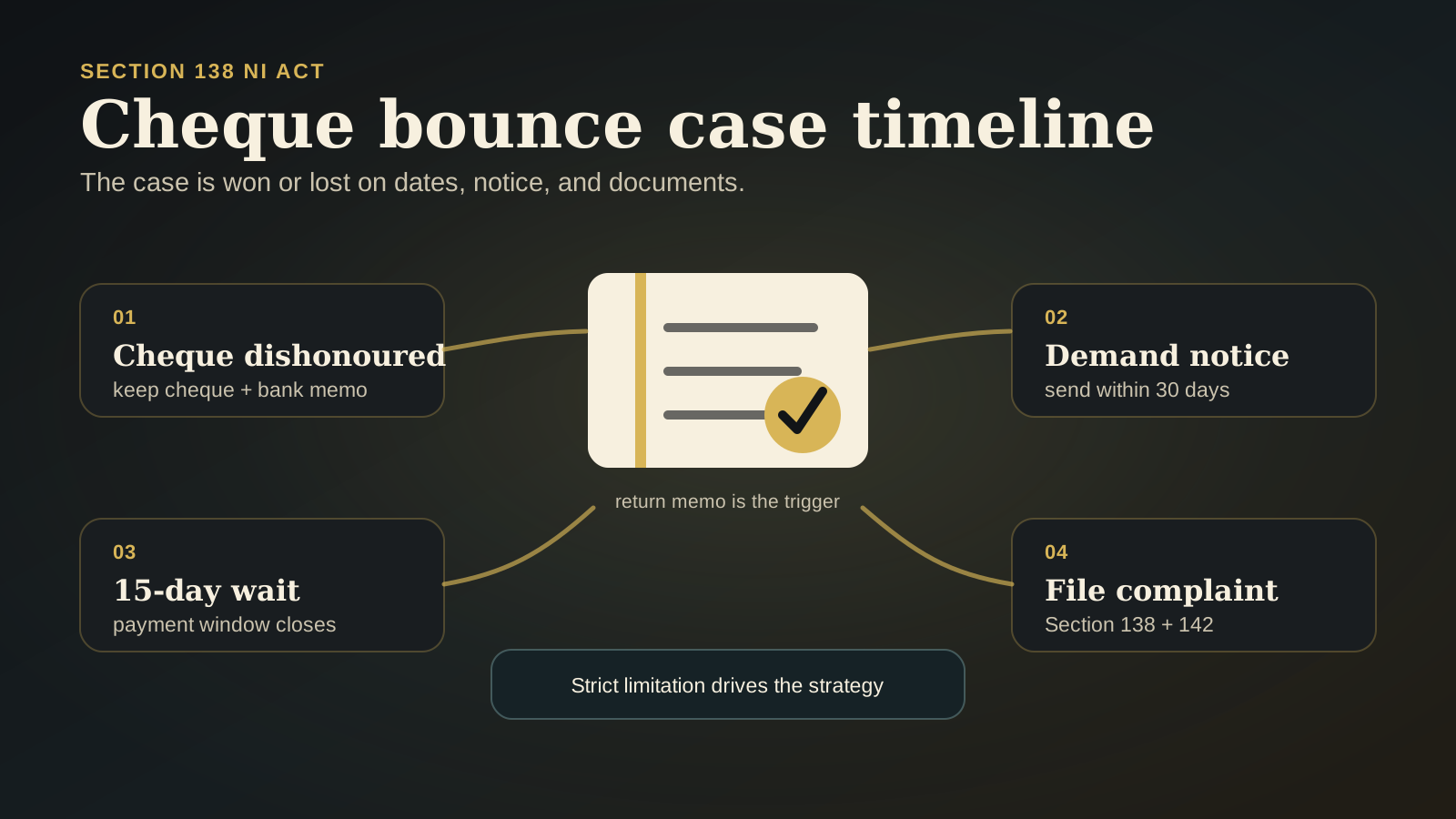
Step 1: The cheque must be presented and dishonoured
The cheque must be presented to the bank within its validity period — currently three months from the date on the cheque. If the bank returns it unpaid with a memo citing "insufficient funds," "exceeds arrangement," or similar grounds, the statutory clock starts. It is essential to preserve the original cheque, the bank return memo, and any bank statements showing the presentation. These documents form the foundation of the case.
If the cheque was dishonoured for reasons unrelated to funds — such as signature mismatch, account closed by the drawer before the cheque was issued, or a stop payment instruction — the legal position differs. Not every dishonour gives rise to a Section 138 prosecution. The dishonour must relate to insufficiency of funds or an arrangement being exceeded.
Step 2: Send the statutory demand notice within 30 days
This is the most critical procedural step, and failure to comply is fatal to the case. Within 30 days of receiving the bank's return memo, the payee must send a written demand notice to the drawer of the cheque. The notice must demand payment of the cheque amount. It is typically sent by registered post with acknowledgement due (RPAD) and, as a practical matter, also by courier and email to ensure proof of dispatch.
The notice should identify the cheque (number, date, amount, bank), state that it was presented and dishonoured, and demand payment within 15 days of receipt. The 30-day window is strict — if the notice is not dispatched within this period, the right to prosecute under Section 138 is lost entirely. There is no court discretion to condone this delay.
Step 3: Wait 15 days for payment
After the drawer receives the demand notice, the law gives them 15 days to make payment. If payment is made within this period, the matter ends — no prosecution can follow. If no payment is made within 15 days of receipt, the offence is complete, and the payee has the right to file a criminal complaint.
Step 4: File the complaint within 30 days
The complaint must be filed before the court of the competent Magistrate within 30 days of the expiry of the 15-day payment window. This means the complaint window opens on day 16 after the drawer received the notice, and closes 30 days later. The Supreme Court has held that in appropriate circumstances, courts can condone a short delay in filing, but this requires a specific application and cannot be assumed. Filing within time is strongly advisable.
The complaint is filed under Section 138 read with Section 142 of the NI Act. It must be accompanied by an affidavit and the relevant documents: the original cheque, the bank return memo, a copy of the demand notice, proof of dispatch, and any underlying agreement or communication establishing the legally enforceable debt or liability for which the cheque was issued.
Step 5: Cognisance and summons
The Magistrate examines the complaint and the supporting documents. If a prima facie case is made out, cognisance is taken and summons are issued to the accused. The accused must appear before the court on the designated date. If the accused does not appear despite service, the court may issue bailable warrants and, in cases of persistent non-appearance, non-bailable warrants.
Step 6: The accused's plea and the trial
Once the accused appears, the court records the plea. If the accused pleads not guilty, the case proceeds to trial. The complainant leads evidence first — typically through an affidavit-in-evidence followed by cross-examination. The defence then has the opportunity to lead its evidence. In cheque bounce cases, the NI Act creates a presumption under Section 139 that the cheque was issued for the discharge of a legally enforceable debt or liability. This means the burden shifts to the accused to rebut the presumption — a significant procedural advantage for the complainant.
Compensation and sentencing
If the accused is convicted, the court may impose imprisonment up to two years and a fine up to twice the cheque amount. More significantly, under Section 143A of the NI Act (introduced in 2018), the court can direct the accused to pay interim compensation of up to 20% of the cheque amount during the pendency of the case. This was a significant reform — it means the complainant does not have to wait until the conclusion of the trial to receive some portion of the amount due.
On conviction, the court typically directs payment of compensation equal to or exceeding the cheque amount. If the accused appeals, Section 148 of the NI Act requires the appellate court to direct deposit of a minimum of 20% of the fine or compensation awarded by the trial court as a condition for suspending the sentence during appeal.
Timeline: how long does this take?
Cheque bounce cases were intended to be disposed of within six months. In practice, in busy metropolitan courts including Delhi, cases routinely take two to four years. The 2018 amendments introducing interim compensation and deposit requirements during appeal were designed to reduce delay by making prolonged litigation more costly for the accused. Despite this, case management and adjournments remain a reality. Early and well-prepared filing helps — a case with clean documentation and a clear chain of events moves faster than one where the complainant's record is incomplete.
Common defences and how to anticipate them
The most common defences raised include: the cheque was issued as security and not for a legally enforceable debt; the underlying transaction was disputed or the debt was already repaid; the notice was not received or was defective; the complaint was filed beyond limitation; and the cheque was obtained by fraud or coercion. A well-drafted complaint that addresses the nature of the underlying liability and a complete set of supporting documents significantly reduce the scope for these defences to succeed.
In cheque bounce and dishonour of cheque matters, Vikram Singh Kushwaha has handled cases involving commercial transactions, loan repayments, and disputed liabilities, with attention to the strict timelines and evidentiary requirements that determine the outcome.
The key to a successful cheque bounce prosecution is discipline: strict compliance with timelines, a properly drafted demand notice, and a complaint supported by a clean documentary record from the outset.
Charges for a bounced cheque in India in 2026
People searching for charges for bounced cheque or check bouncing charges are often asking about two different costs. First, banks charge their own cheque-return or ECS-return fee to the drawer and sometimes to the payee. The exact amount varies by bank, account type, cheque value and whether the return is local, outstation, ECS, NACH or inward / outward clearing. Large private banks commonly levy a few hundred rupees per dishonour, while repeated ECS / NACH bounces can attract additional mandate-return charges. Always check the latest schedule of charges on the issuing bank's website before quoting a number in a notice.
Second, Section 138 NI Act creates legal exposure that is far larger than the bank charge: compensation, fine up to twice the cheque amount, settlement costs and litigation expenses. The bank's memo is important because it proves dishonour, but the legal case turns on debt, notice, limitation and payment failure after demand.
Punishment for cheque bounce under Section 138
The punishment may extend to two years' imprisonment, fine up to twice the cheque amount, or both. In commercial reality, many cases are compounded through settlement. Accused-side defences are covered in the companion article on cheque bounce punishment and defences.
Frequently asked questions
How do I file a cheque bounce case in India?
Present the cheque within its validity period, obtain the bank return memo, send a written demand notice to the drawer within 30 days of dishonour, wait 15 days for payment, and if unpaid, file a criminal complaint under Section 138 of the Negotiable Instruments Act before the competent Magistrate within 30 days.
What is the punishment for cheque bounce under Section 138?
The punishment may extend to two years' imprisonment, a fine up to twice the cheque amount, or both. Courts can also direct interim compensation of up to 20% of the cheque amount during the pendency of the case under Section 143A of the NI Act.
What is the time limit for sending a legal notice after a cheque bounces?
The payee must send a written demand notice to the drawer within 30 days of receiving the bank's return memo. This deadline is strict and cannot be condoned by any court. Failure to send the notice within 30 days extinguishes the right to prosecute under Section 138.
What is the limitation period for filing a cheque bounce complaint?
The complaint must be filed within 30 days from the date the 15-day payment window expires after the drawer receives the demand notice. Courts may condone a short delay in appropriate cases, but filing within the prescribed period is strongly advisable.
Holding a dishonoured cheque and need to take action?
Share the cheque details, the bank return memo, and a summary of the underlying transaction for an assessment of the case and the next procedural step.
Consultation & feesSection 138 timelines are unforgiving — see how a cheque bounce lawyer in Delhi runs notice, complaint and trial without losing limitation.
