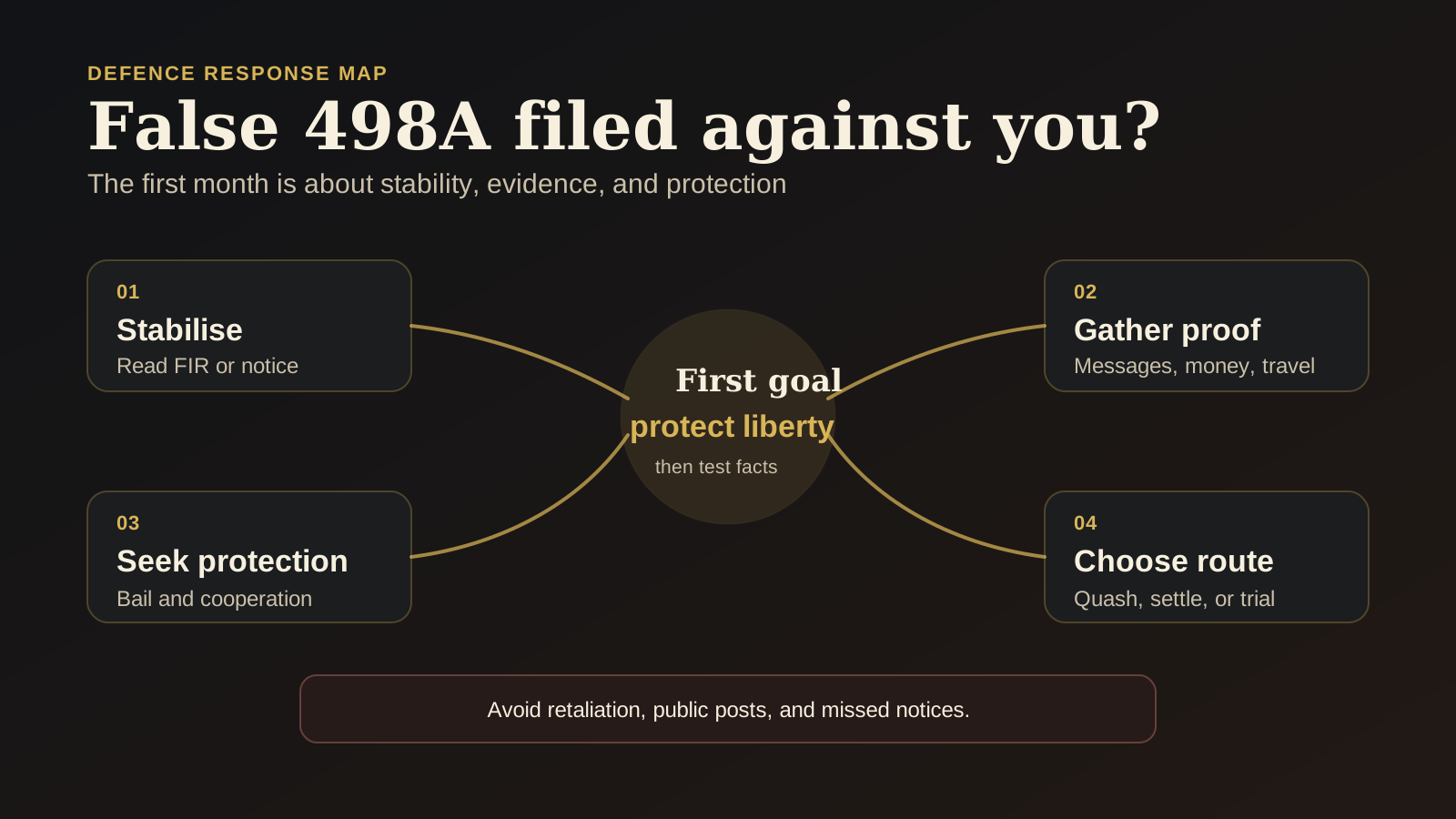
Section 498A of the Indian Penal Code — now Section 85 of the BNS, with cruelty defined in Section 86 — makes it a criminal offence for a husband or his relatives to subject a married woman to cruelty, and the offence is cognisable and non-bailable. The immediate concern is therefore arrest, and the first line of defence is anticipatory bail. Where the FIR discloses no offence even taken at face value, quashing before the High Court is the route. Build the documentary defence early: the case is usually won or lost on contemporaneous records.
Section 498A of the Indian Penal Code (now Section 85 BNS, with cruelty defined in Section 86 BNS) makes it a criminal offence for a husband or his relatives to subject a married woman to cruelty. It was enacted to protect women from dowry harassment and domestic abuse. The offence is cognisable and non-bailable, which means police can arrest without a warrant and bail is not available as of right at the police station level.
The provision serves an important purpose. But the Supreme Court itself has observed — most notably in Sushil Kumar Sharma v. Union of India (2005) and Arnesh Kumar v. State of Bihar (2014) — that the section is sometimes misused as a tool for harassment or as leverage in matrimonial disputes. For those who find themselves at the receiving end of a false or substantially exaggerated 498A complaint, the experience is alarming — particularly because of the threat of arrest. This guide addresses what you can do.
The immediate concern: arrest
The first and most pressing concern when a 498A FIR is lodged is the possibility of arrest. Following the Supreme Court's guidelines in Arnesh Kumar, police officers are required to satisfy themselves that arrest is necessary before making one in cases punishable with imprisonment up to seven years. The court directed that police must follow a checklist under Section 41 CrPC (now Section 35 BNSS) before arresting. In practice, however, compliance varies, and the risk of arrest remains real.
If you learn that a 498A complaint has been filed — whether through a police call, a notice, or information from the other side — the immediate step is to consult a criminal lawyer and assess whether anticipatory bail is necessary and on what terms.
Anticipatory bail: the first line of defence
Anticipatory bail under Section 438 CrPC (Section 482 BNSS) is an application made to the Sessions Court or the High Court seeking protection from arrest in the event of arrest. If granted, it means that if you are arrested, you will be released on bail immediately, without spending time in custody. In 498A cases, anticipatory bail applications are extremely common and courts are generally familiar with the dynamics involved.
The application must set out the facts, explain why the allegations are false or exaggerated, and demonstrate that you are not a flight risk and will cooperate with the investigation. Courts consider the nature of the allegations, the severity of the offence, the applicant's antecedents, and whether there is a genuine apprehension of arrest. In Delhi, both the Sessions Court and the Delhi High Court regularly hear and grant anticipatory bail in 498A matters where the facts support it.
What the investigation looks like
Once an FIR is registered, the police will investigate. This typically involves recording statements from the complainant and witnesses, calling the accused for questioning (under Section 160 CrPC / Section 179 BNSS — a notice to attend, not an arrest), and collecting documents. If you have anticipatory bail, you attend the police station as required by the bail conditions. You are not obligated to give a confessional statement to the police, and any statement to the police is not admissible as evidence against you in court.
The investigation may lead to a charge sheet being filed if the police find sufficient evidence, or to a closure report if they do not. Where a case involves both genuine and exaggerated allegations, the charge sheet may narrow the scope of the complaint. Your lawyer should monitor the investigation closely and ensure that exculpatory evidence is brought to the investigating officer's attention in a documented manner.
Quashing the FIR: the High Court route
If the FIR is based on allegations that are patently false, vague, or do not disclose the ingredients of the offence, the accused can file a petition under Section 482 CrPC (Section 528 BNSS) before the High Court seeking quashing of the FIR or the criminal proceedings. The High Court has inherent power to quash proceedings to prevent abuse of the process of the court or to secure the ends of justice.
Quashing is not automatic. The High Court will examine the FIR on its face, and if the allegations — even taken at face value — do not make out the offence, the FIR may be quashed. Additionally, where the parties reach a settlement in the matrimonial dispute, the High Court can quash the 498A proceedings by consent, provided the court is satisfied that the settlement is genuine and not coerced. The Supreme Court in B.S. Joshi v. State of Haryana (2003) and Gian Singh v. State of Punjab (2012) has affirmed this power.
Impact on other proceedings
A 498A complaint rarely exists in isolation. It is almost always accompanied by related proceedings: a domestic violence case under the DV Act, a maintenance petition under Section 125 CrPC or under the DV Act, and often a divorce petition. The 498A case and the divorce case affect each other — allegations made in one are used in the other. Strategy must be coordinated across all proceedings. Inconsistencies between the complainant's different cases can be significant at trial.
Building the defence
The defence in a 498A case is document-intensive. Relevant evidence includes: correspondence, messages, and communications that contradict the allegations of cruelty; evidence of the complainant's own conduct; medical records (where physical violence is alleged but not supported); financial records showing the absence of dowry demands; and evidence that the complaint was filed in the context of and as leverage for a matrimonial dispute rather than to report genuine abuse.
Where the complaint names the husband's family members — parents, siblings, distant relatives — who had no involvement in the alleged cruelty, their separate defence must be built. Courts have become increasingly critical of omnibus complaints that name entire families without specific allegations against each person, and this is a legitimate ground for seeking quashing of the case against those family members.
The trial and what to expect
If the case proceeds to trial, the complainant must prove the allegations beyond reasonable doubt. The prosecution leads evidence, the defence cross-examines, and the defence may then lead its own evidence. In 498A cases, cross-examination of the complainant is often the most significant phase — inconsistencies, contradictions with other proceedings, delayed complaints, and the absence of corroboration are all tested. Trials in Delhi courts typically take two to five years depending on the court's calendar and the complexity of the matter.
In cases involving 498A complaints and related matrimonial criminal proceedings, Vikram Singh Kushwaha has handled anticipatory bail applications, quashing petitions, and trial defence before Delhi courts, with a focus on documentary evidence and cross-proceeding strategy.
The objective in a false 498A defence is not merely acquittal — it is protecting the accused's liberty, reputation, and the dignity of their family while the legal process runs its course.
What is Section 498A IPC?
498A IPC, often searched as 498a, 498a indian penal code, section 498a, dhara 498 or ipc 498, is the provision that criminalised cruelty by a husband or his relatives towards a married woman. Cruelty covers conduct likely to drive the woman to suicide or cause grave injury, and harassment linked to unlawful demands for property or valuable security. The offence is cognisable and non-bailable, but arrest is not meant to be automatic after Arnesh Kumar v. State of Bihar.
Sections 85-86 BNS after 1 July 2024
For alleged conduct after 1 July 2024, the charge is framed under Section 85 BNS and the definition of cruelty appears in Section 86 BNS. Pending IPC cases continue under the old law, while new filings must account for BNS and BNSS numbering. The substantive defence concerns remain familiar: specific allegations, contemporaneous record, arrest necessity, settlement possibility and quashing where allegations are vague or omnibus. For a full explainer, see Section 498A IPC explained.
Frequently asked questions
What should I do immediately if a false 498A FIR is filed against me?
Consult a criminal lawyer immediately to assess whether anticipatory bail is needed. Do not make any statement to the police without legal advice. Secure all documentary evidence — messages, financial records, correspondence — that contradicts the allegations.
Is 498A bailable or non-bailable?
Section 498A IPC (now Sections 85-86 BNS) is a non-bailable offence. However, the Supreme Court in Arnesh Kumar v. State of Bihar directed that arrest should not be automatic, and anticipatory bail is routinely granted where the facts support it.
What is the punishment for filing a false 498A case in India?
Filing a false criminal complaint can attract prosecution for perjury, giving false evidence, and malicious prosecution. Courts have also awarded costs and compensation to the accused in cases where 498A was found to be grossly misused.
Facing a 498A complaint and need immediate legal advice?
Share the FIR details, any notices received, and a summary of the matrimonial situation for an assessment of the best available defence strategy.
Consultation & feesA false-implication defence needs early, documented groundwork — see how a criminal defence lawyer in Delhi structures the first 30 days.
