There is no offence called "DUI" in Indian law — the Indian equivalent is drink and drive, prosecuted primarily under Section 185 of the Motor Vehicles Act. The offence turns on blood alcohol concentration exceeding the prescribed limit or on being under the influence of drugs. Bail is usually grantable, though with conditions. Where the driving causes death or injury the matter moves beyond Section 185 into far more serious offences, and that is the distinction which decides how the case should be handled.
Scope and jurisdiction at a glance
- The offence
- There is no offence called "DUI" in Indian law. Driving under the influence is prosecuted under Section 185 of the Motor Vehicles Act 1988, which applies where a person drives with alcohol exceeding the prescribed limit in blood, or is under the influence of a drug to such an extent as to be incapable of exercising proper control of the vehicle.
- The prescribed limit
- The statutory threshold is 30 mg of alcohol per 100 ml of blood, detected by a breath analyser or in a laboratory test.
- Punishment
- A first offence attracts imprisonment which may extend to six months, or a fine, or both. A second or subsequent offence committed within three years of the previous one attracts a higher punishment. The section prescribes the current figures and these have been revised by amendment, so confirm the position in force.
- Which court
- The offence is tried by a Magistrate having jurisdiction over the place where the offence was committed. In Delhi such matters are frequently dealt with through the virtual court or, where the accused elects, in the regular Magistrate's court.
- Bail position
- The offence is generally bailable, and bail is ordinarily granted, though the court may impose conditions. Where the driving has caused death or grievous hurt the matter moves beyond Section 185 into offences under the Bharatiya Nyaya Sanhita, and the bail position changes accordingly.
- Licence consequences
- Conviction can lead to disqualification from holding a driving licence, which is a separate consequence from the fine or sentence and is frequently the more significant one for the person concerned.
- Where refusal to be tested is alleged
- Refusing to submit to a breath test where lawfully required is itself an offence under the Act, and refusal does not avoid the consequences of Section 185.
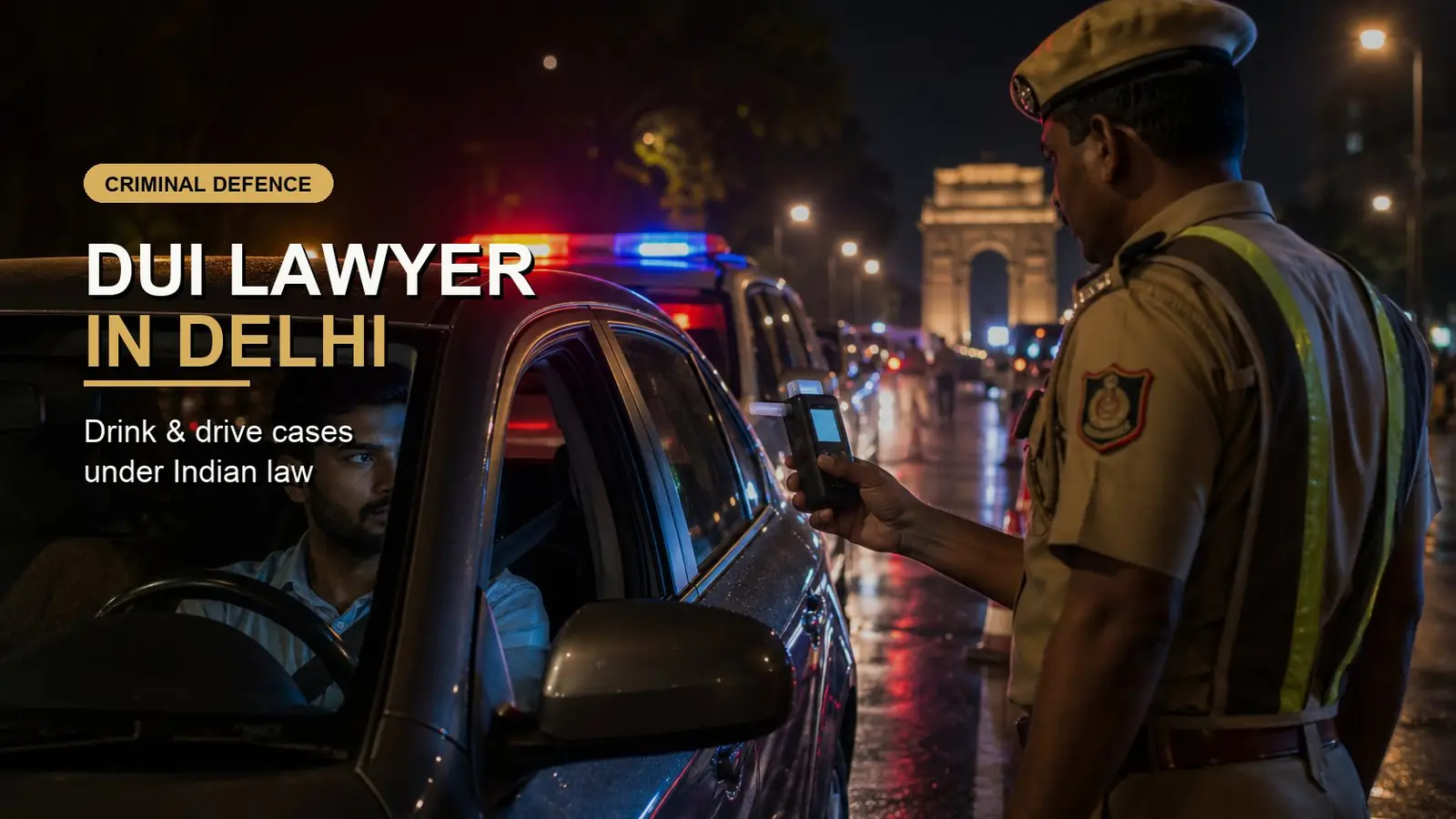
People who search for a "DUI lawyer near me" in India are usually borrowing the phrase from American films, US news, or a relative abroad. There is no offence called DUI in Indian law. The Indian equivalent is "drink and drive," and it is prosecuted primarily under Section 185 of the Motor Vehicles Act, 1988. Where the driving causes injury or death, the case escalates to the Bharatiya Nyaya Sanhita (BNS) and what was earlier the Indian Penal Code.
The terminology matters because it changes the procedure, the bail position, the fine, and whether jail time is on the table. This article walks through what a person searching for a "DUI lawyer in Delhi" usually actually needs.
The statute: Section 185 of the Motor Vehicles Act
Section 185 makes it an offence to drive, or attempt to drive, a motor vehicle when the alcohol level in the blood exceeds 30 mg per 100 ml, or when the person is otherwise under the influence of a drug to such an extent as to be incapable of exercising proper control. The reading is taken by a breath analyser at the spot.
Penalties were enhanced under the Motor Vehicles (Amendment) Act, 2019. A first offence now attracts up to six months in prison or a fine of up to Rs. 10,000 (or both). A second or subsequent offence within three years can attract up to two years in prison or a fine of up to Rs. 15,000 (or both). The licence may also be suspended.
When a "DUI" case becomes something more serious
If the driving caused injury or death, the case is not tried only under the Motor Vehicles Act. It crosses into BNS provisions on rash and negligent driving and, in fatal cases, culpable homicide not amounting to murder. The Supreme Court has, in successive judgments, taken a stricter view of drunk driving fatalities, and trial courts now scrutinise these matters carefully.
The forum also changes. A pure Section 185 charge is tried by the Magistrate. A drunk-driving case involving death may move to a Sessions Court depending on the section invoked.
Bail position: usually grantable, but with conditions
For a first-time Section 185 offence with no injury or accident, bail is typically granted by the Magistrate on personal bond. Where the offence is compounded with injury or death, the bail picture becomes much harder and may require an application before the Sessions Court or, in serious cases, anticipatory bail before any FIR is even formally registered.
If the police have served notice or there is reason to apprehend arrest because the incident involved injury or death, the right step is usually an anticipatory bail application under Section 482 of the BNSS (formerly Section 438 CrPC).
What a competent advocate will look at first
- The breath-analyser reading and the procedure followed at the time of testing.
- Whether the device was certified, calibrated, and operated by an authorised person.
- Whether the demand for the breath sample was lawful in the circumstances of the stop.
- Whether any injury, accident, or property damage is alleged — this changes the entire case.
- Whether a charge under the Motor Vehicles Act has been combined with BNS provisions, and if so, on what factual basis.
- The applicant's prior record, including any past Section 185 conviction within three years.
What if the case is in Delhi specifically?
Drink-and-drive cases in Delhi are typically registered through the Traffic Police and tried before the Metropolitan Magistrate at the relevant district court complex — Saket, Patiala House, Tis Hazari, Karkardooma, Rohini, or Dwarka, depending on the location of the incident. Where the case escalates to a sessions matter, it is committed to the corresponding Sessions Court. Anticipatory bail applications go to the Sessions Court or the Delhi High Court depending on urgency and complexity.
So if you searched "DUI lawyer near me" — what next?
The realistic answer is that you need a criminal defence lawyer in Delhi who has handled Section 185 cases and, where applicable, the related BNS sections. The case may be straightforward (a small fine, a closed file, a licence-suspension argument) or genuinely serious (custodial risk, sessions trial, victim-side opposition). The first hour is usually about reading the FIR or the spot challan and assessing which of the two it is.
In drink-and-drive matters, Vikram Singh Kushwaha has handled both first-instance Magistrate hearings and sessions-level matters where the prosecution combined Section 185 with BNS provisions following an accident. His approach is to assess the breath-analyser record, the procedural compliance at the spot, and the underlying facts before deciding whether to fight, settle, or move for bail.
Frequently asked questions about drink-and-drive cases in Delhi
Is DUI the correct legal term in India?
No. Indian law usually refers to drink and drive offences under Section 185 of the Motor Vehicles Act, though the word DUI is commonly used by people searching online.
What documents matter in a Delhi drink-and-drive case?
The challan, FIR if any, breath-analyser record, vehicle documents, licence status and any accident or injury record are usually the first documents to review.
Do I need a lawyer for a drink-and-drive challan in Delhi?
It depends on the breath-analyser reading, whether an accident occurred, whether BNS provisions were added, and whether licence suspension or bail risk is involved.
Need a criminal defence lawyer for a drink-and-drive case in Delhi?
Share the challan, the FIR if registered, and any breath-analyser record so the immediate procedural posture can be assessed.
For court representation in a Section 185 matter, see how a criminal lawyer in Delhi for drink-and-drive cases handles challans, bail and licence consequences.