Painting a copy of an existing artwork reproduces the artist's expression, and reproduction is one of the exclusive rights the Copyright Act 1957 reserves to the rights-holder. Copyright protects expression rather than idea, so the bowler hat and the apple as concepts are free while the particular composition is not. Fair dealing in India is narrower than most people assume and does not include a general "personal use" exemption. Moral rights — attribution and integrity — survive independently of the economic rights and outlast their assignment.
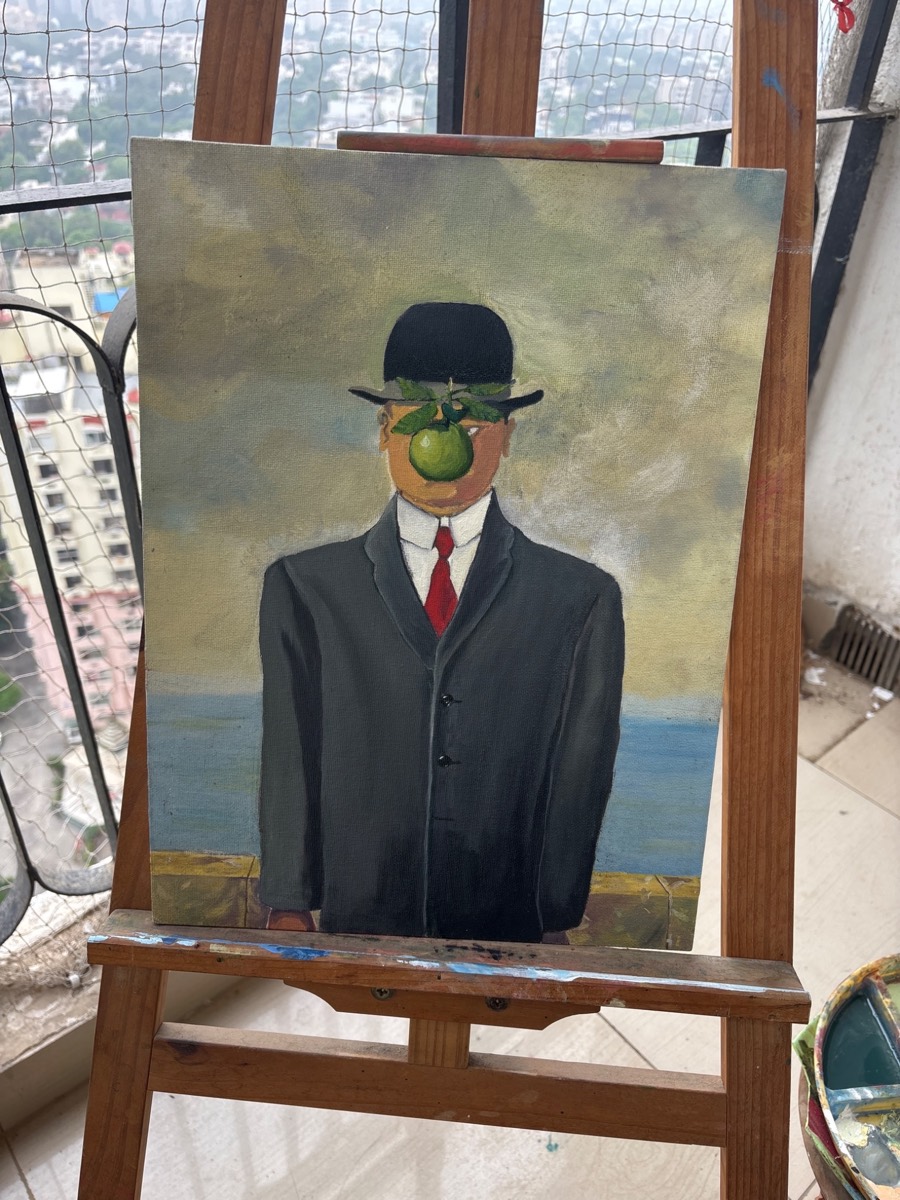
I painted my version of The Son of Man over several weekends in 2023. The original — a man in a bowler hat with a hovering green apple eclipsing his face — was completed by René Magritte in 1964. Mine is, on any honest accounting, a copy. The composition is his. The palette is his. The bowler hat, the apple, the grey overcast sky, the low wall behind the figure — all his. What is mine is the labour of looking, mixing, and putting paint on canvas in roughly the right places. The pleasure of the exercise, and the reason I keep doing it, is that this is exactly the kind of looking that copyright lawyers should do more of: slow, attentive, and uncomfortable with easy answers.
It is also the kind of looking that throws up real legal questions. If I sold the painting, would I be infringing Magritte's copyright? If I displayed it on my website, would the answer change? Does it matter that Magritte died in 1967, or that the painting hangs in a private collection thousands of kilometres from Delhi? Would my position be any different if I had painted it from a postcard rather than a high-resolution scan? These are not abstract questions. They are the questions that arise every time a designer reworks a film still, a YouTuber edits over a song, a meme account remixes a news photograph, or a fine-art student exhibits a study from the Louvre. The answers in Indian law are more textured than they look.
What copying actually triggers under the Copyright Act
The Copyright Act, 1957 protects "artistic works" as a class — a category that, under Section 2(c), expressly includes paintings, drawings, photographs and works of artistic craftsmanship, whether or not they have any artistic quality. A painting completed in Brussels in 1964 is unambiguously an artistic work. Magritte's estate is the present copyright holder, and India, as a signatory to the Berne Convention and through the International Copyright Order, 1999 (issued under Section 40 of the Act), extends copyright protection to foreign works on substantially the same footing as Indian works.
Section 14(c) tells us what the owner of copyright in an artistic work is entitled to control. It is the exclusive right to reproduce the work in any material form, including by depicting it in two or three dimensions; to issue copies to the public; to communicate the work to the public; and to make any adaptation of the work or any reproduction of an adaptation. A faithful oil-on-canvas version of an existing painting is squarely a reproduction "in any material form". The fact that the original is also a painting and the copy is also a painting is irrelevant to whether reproduction has occurred. So is the medium, the size, and the skill of execution.
Section 51 then makes it an infringement to do, without the owner's licence, anything that the owner alone is entitled to do. Reproduction without permission is therefore infringement on the face of the statute. Whether it is also an actionable wrong in practice is where the rest of the Act, and the case law, do most of the work.
Copyright, trademark and creator-side disputes — takedowns, cease-and-desist responses, oppositions and enforcement.
Intellectual property & copyright →Idea, expression, and where copying becomes copyright
Indian copyright doctrine, like every copyright system that descends from the Statute of Anne, refuses to protect ideas as such. Only expression is protected. The Supreme Court's foundational articulation came in R.G. Anand v. Delux Films, where the Court held that no copyright subsists in an idea, theme, or plot, but the form in which a work is dressed up may be protected. The 1978 framework — the test of whether the average reader is left with the unmistakable impression that the later work is a copy of the original — has been refined many times since but never displaced.
The idea-expression distinction is more elastic in visual art than the case law sometimes admits. The idea of a man in a suit with an apple where his face should be is not, by itself, anyone's property. The particular composition Magritte made of that idea — the precise placement, the colour values, the specific apple, the specific overcoat — is. A different painter who took the same conceit and produced an entirely different image (say, a woman with a pear, in a different palette, different posture, different background) would not be reproducing Magritte's expression. They would be borrowing his idea, which the Copyright Act does not forbid. What I did was something else. I reproduced the expression itself, faithfully, in the same medium. That is the kind of copying that the doctrine is built to address.
The line between style and expression matters more in IP practice than people realise. Clients regularly arrive convinced that someone has "stolen their style". Style is rarely protectable. A pointillist technique, a noir colour palette, a long-exposure approach to street photography — these are working methods. They sit on the idea side of the line. Where a client has a viable claim, it is almost always because specific expressive choices — a recognisable composition, a particular character design, a sequence of images, a verbal or visual phrase — have been reused.
Fair dealing: narrower than people assume
Many practitioners, especially those who read US case law more often than Indian statute, instinctively reach for "fair use" when defending a derivative work. Indian law does not have a fair use doctrine. It has fair dealing under Section 52, which is a closed list. The most commonly invoked heads under Section 52(1)(a) are private or personal use including research, criticism or review, and reporting current events. Each is read narrowly. There is no general transformative-use defence of the kind the US Supreme Court applied in Campbell v. Acuff-Rose Music and, more recently and more restrictively, in Andy Warhol Foundation v. Goldsmith.
A copy hanging on a wall at home — never sold, never exhibited, never licensed — is the kind of use the doctrine was never built to police, and as a practical matter rarely is. There is no specific Section 52 head that names "private display of a copy in the artist's home", which is precisely the closed-list problem. The strongest reading is that such use sits below the threshold of meaningful enforcement risk rather than within a clean statutory exception. The moment the work is sold, exhibited commercially, or used in a campaign, the analysis changes — and changes against the copyist. Display on a personal website that is not commercialising the image is a closer question. Courts in India have not directly ruled on portfolio display of student studies and copies, and the answer is likely to depend on whether the display is decorative, educational, or transactional in nature. In my own case, I display the painting on the site as part of a biographical context, not as a work for sale. Reasonable counsel could disagree about the margin. The honest position is that the closer the use moves to commercial exploitation, the weaker any colourable defence becomes.
It is worth noting that India's fair dealing under Section 52 is somewhat broader than the United Kingdom's, which retains an even tighter list. It is significantly narrower than the open-ended US fair use balancing test. A practitioner advising on a borderline derivative work should never quietly substitute the more permissive doctrine into the Indian analysis. The Section 52 list is the list, and "transformative use" is not on it.
The line between "inspired by" and "copied from" is sometimes clear, sometimes contested, and always fact-specific. A faithful oil-on-canvas version is squarely a reproduction "in any material form".
Term, public domain, and the strange afterlife of mid-century art
Magritte died in 1967. Under Indian law, copyright in an artistic work subsists for the lifetime of the author plus sixty years, calculated from the beginning of the calendar year following the year of death. The painting will accordingly enter the public domain in India on 1 January 2028. Until then, the estate has, in India, all the rights set out in Section 14(c) — including the right to authorise or refuse reproductions.
This produces an awkward asymmetry, because Belgium, France and most EU jurisdictions apply a seventy-year term measured from the end of the author's year of death, meaning The Son of Man enters the public domain in those jurisdictions only in 2038. The work might therefore be lawfully reproduced in India a decade before it can be lawfully reproduced in its country of origin. Cross-border reproduction — say, an Indian publisher printing a book of essays on Magritte for international distribution — would still have to navigate the longer term wherever the book is sold. Term differentials are the kind of thing that look academic in the textbook and matter very much when a publisher is structuring a global release.
Moral rights, which survive the copyright
Section 57 of the Copyright Act preserves two rights for authors that do not transfer with the assignment of economic rights and that cannot be waived in advance: the right of paternity (to be identified as the author of the work) and the right of integrity (to object to any distortion, mutilation, modification, or other act in relation to the work that would be prejudicial to the author's honour or reputation). These rights are personal to the author and survive even after copyright assignment.
The Delhi High Court's decision in Amar Nath Sehgal v. Union of India remains the most striking statement of Indian moral rights jurisprudence. The Court held that the Union, having acquired physical custody of Sehgal's mural for the Vigyan Bhavan lobby, could not consign it to a storeroom in pieces. Moral rights, the Court observed, are foundational to the very dignity of authorship. The case is sometimes cited as Indian law going further than its sources required, and that reading is fair. It means that even where someone owns the copyright, they do not own the right to disfigure the work and call it the author's. For a derivative-work practitioner, the implication is that an alteration of an existing work — adding to it, cropping it, recolouring it, photoshopping it — can attract a moral-rights claim quite independent of the copyright analysis.
This is the part where my own practice teaches me something. When I sit with a Magritte for forty hours and try to copy it, I begin to notice the choices the painter made — the placement of the apple a centimetre to the right of dead centre, the small asymmetries in the overcoat that make the figure feel weighted. These are the choices that, in legal language, constitute "the form in which the idea is dressed up". You cannot understand what a copyright protects until you have tried, badly, to reproduce it. The moral-rights instinct in Indian law — that the author's identity is bound up with these choices and survives sale — is not an abstract idea. It is a workshop-floor recognition.
Comparative aside: Cariou, Warhol, and the limits of analogy
Practitioners advising Indian clients on derivative works inevitably encounter the US fair-use cases. They should be cited carefully. Cariou v. Prince, the Second Circuit's 2013 decision on Richard Prince's reworking of Patrick Cariou's Rastafarian photographs, found most of Prince's works transformative and therefore protected. For years afterward, that decision was the high-water mark of transformative-use doctrine, and was cited well beyond its facts. The US Supreme Court's 2023 decision in Andy Warhol Foundation v. Goldsmith pulled the doctrine sharply back. The Court held that Warhol's silkscreen of Prince — based on Lynn Goldsmith's photograph — was not transformative when used commercially for the same purpose as the original (a magazine portrait). Transformation, the majority emphasised, requires more than aesthetic change; it requires a different purpose or character.
This matters in two ways for Indian practice. First, even the leading transformative-use jurisdiction in the world has tightened the test. Second, India does not have transformative use as a defence at all. Practitioners who carry over US-style transformation arguments to Section 52 are arguing from a doctrine that does not exist in the statute. The strongest Indian arguments for permissible derivative use rest where the statute does — in the specific Section 52 heads, in fair dealing as actually defined, and in the idea-expression distinction.
What this means for clients who copy, riff, and reference
The practical map for an Indian creator or commercial user thinking about derivative work is short and worth stating plainly. Faithful reproductions of in-copyright works require a licence. Recognisable derivatives — paintings, photographs, films, or designs that retain the protected expression of an existing work — require either a licence or a defence under Section 52, and the Section 52 defences are narrower than US fair use. Style, technique, and idea are not protected. Specific compositions, characters, and recognisable expressive choices are. Term varies by jurisdiction, and works that have entered the public domain in one country may still be protected in another. Moral rights survive the assignment of economic rights and can be asserted by the author or, after death, by the author's legal representatives.
For an art practice like mine — copies as study, displayed without sale and without claim to authorship — the legal exposure is genuinely low, but it is not zero. The honest answer is that the doctrine has not been tested against this kind of personal display, and the strongest protection a copyist can offer is unambiguous attribution and a refusal to commercialise the work. For commercial clients in IP-adjacent businesses — design studios, advertising agencies, content creators, publishers — the risk is higher and the diligence required is greater. Clearance is cheaper than litigation. Licences, where the rights are licensable, are cheaper still.
Why I think this is good practice for IP lawyers
The reason I keep painting is not that it makes me a better lawyer in some advertisement-ready way. It is that the kind of attention painting demands is the same kind of attention that good copyright analysis demands. You learn to see what was actually done by an author rather than what you assumed they had done. You learn that the difference between two compositions that look superficially similar may rest on a single weighted choice that took the artist three days to make. You learn that copying is harder than it looks, and that imitation is often where understanding begins.
Indian copyright doctrine, at its best, treats authorship with the seriousness it deserves — the moral-rights jurisprudence in Sehgal is a clear example. It also leaves derivative-use cases harder to defend than US doctrine does, which is a feature rather than a bug if one believes that the author's hold on the work should be the default and exceptions should be narrow. Whether you find that balance correct is a separate question. As a working IP practitioner, the discipline that the statute imposes — analyse the protected expression, identify the specific use, ask whether a Section 52 head applies — is one I find I can carry from the canvas to the file and back.
For artists, brands, and creators thinking about a derivative work, the most useful conversation usually happens before the work is made. It is when the project is at the sketch stage that clearance, licensing, and defence strategy are cheapest to design. By the time a finished work is in front of a notice or a court, the room to manoeuvre has narrowed considerably.
Working on a derivative or reference-based project, or facing a takedown over one?
Share the work, the source, and the proposed use for a structured view of clearance options, licensing routes and the defences that may be available under Section 52.
Consultation & fees