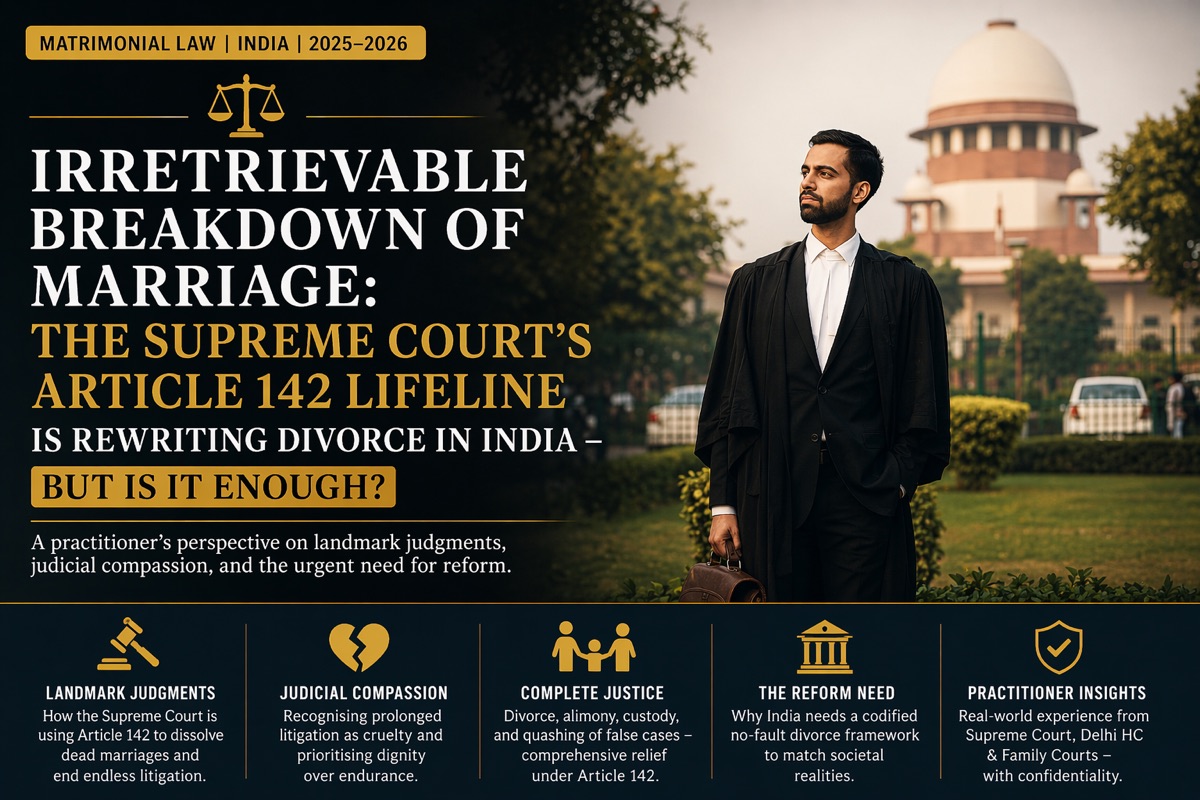
Short answer. Article 142 of the Constitution is the Supreme Court's extraordinary power to pass "such decree or order as is necessary for doing complete justice" in any pending matter. It is the provision the Court invokes when ordinary statutory remedies fall short — to dissolve an irretrievably broken marriage, to waive procedural waiting periods, to quash proceedings in settled disputes, and to grant shape-shifted relief in urgent situations. Understanding when Article 142 can be argued, and when it will not be granted, is often decisive in a high-stakes Supreme Court matter.
Scope and jurisdiction at a glance
- What the power is
- Article 142(1) of the Constitution empowers the Supreme Court, in the exercise of its jurisdiction, to pass such decree or make such order as is necessary for doing complete justice in any cause or matter pending before it. It is a power of the Supreme Court alone — no High Court or subordinate court possesses it.
- When it can be invoked
- Only in a matter already pending before the Supreme Court. Article 142 is not an independent cause of action and a petition cannot be founded on it alone; it supplements the relief available in a proceeding properly before the Court.
- The best-known matrimonial use
- Dissolving a marriage on the ground of irretrievable breakdown, which is not a statutory ground under the Hindu Marriage Act. In Shilpa Sailesh v. Varun Sreenivasan (2023) a Constitution Bench confirmed that the Supreme Court can dissolve a marriage on that basis under Article 142, and can also waive the statutory cooling-off period in a mutual consent petition.
- Its limits
- The power cannot be used to override an express statutory prohibition or to build a new edifice where none existed. The Court has repeatedly said that Article 142 supplements the law and does not supplant it, and it will not be exercised to defeat a substantive statutory provision.
- Transfer plus dissolution
- A common practical use is to convert a transfer petition into a final resolution — where parties in a transfer petition arrive at a settlement, the Court can dissolve the marriage and dispose of connected proceedings in one order rather than remitting them.
- How it reaches the Court
- Through the proceeding already before it — a Special Leave Petition, a transfer petition, a writ petition or an appeal. The relief under Article 142 is sought within that proceeding.
This article explains the provision in plain terms, walks through the most common situations in which it is invoked — especially in matrimonial and criminal matters — and sets out how an urgent application is typically argued.
The text and the idea
Article 142(1) reads, in essence, that the Supreme Court in the exercise of its jurisdiction "may pass such decree or make such order as is necessary for doing complete justice in any cause or matter pending before it". Two phrases do the heavy lifting: complete justice and any cause or matter pending.
"Complete justice" signals that the Court is not confined to granting only the relief that statutes or codes allow for. Where a situation demands a more comprehensive remedy to end a dispute fairly, Article 142 gives the Court headroom to craft it. "Any cause or matter pending" limits the reach — the Court acts within a case that is before it; it does not create jurisdiction in the abstract.
Why it exists
Ordinary statutory remedies are, by design, structured and bounded. A court usually cannot exceed the remedy the statute provides, even if the facts demand more. But litigation sometimes throws up situations where the statutory remedy is simply inadequate — where insisting on the letter of the law would defeat justice. Article 142 is the Constitution's recognition that, at the apex level, there must be a power to close such gaps.
The most common situations where Article 142 is invoked
1. Dissolution of marriage on ground of irretrievable breakdown
The Hindu Marriage Act does not list "irretrievable breakdown of marriage" as a ground for divorce under Section 13. Successive Law Commission reports have recommended its introduction as a statutory ground, but Parliament has not legislated it.
The Supreme Court has, however, in appropriate cases, used Article 142 to dissolve a marriage that has demonstrably broken down beyond repair — where the parties have lived apart for a long period, multiple rounds of litigation have failed to produce any prospect of reconciliation, and continuation of the marriage serves no purpose for either party. In the recent constitutional decision on this question, the Court has clarified that it can grant divorce directly under Article 142 where the breakdown is established and complete justice so requires, without the parties first having to invoke the statutory route.
This is significant: it spares parties what can be years of additional litigation and gives the Supreme Court a tool to bring a prolonged dispute to an orderly end. The relief is discretionary, fact-specific, and is not a substitute for the statutory grounds — parties cannot approach the Supreme Court directly in the first instance for this relief, since Article 142 is exercised in a matter already pending.
2. Waiver of the six-month cooling-off period in mutual consent divorce
Under Section 13B of the Hindu Marriage Act, a mutual consent divorce requires two motions separated by a period of six to eighteen months. This gap is intended to give the parties a chance to reconsider.
In Amardeep Singh v. Harveen Kaur, the Supreme Court held that the six-month period is directory, not mandatory. Where the parties have already lived separately for a long time, the settlement is complete, and the court is satisfied that there is no realistic possibility of reconciliation, Family Courts may waive the waiting period and pass the decree without insisting on the full statutory interval. This decision is routinely invoked in Delhi family courts by parties who have settled comprehensively and simply want the decree issued without further delay.
While the Amardeep Singh waiver itself is applied by family courts, the underlying jurisprudential reasoning — that the Supreme Court can read statutory procedural waiting periods as directory in the interest of justice — is a direct function of its Article 142 outlook.
3. Quashing criminal proceedings in settled matrimonial disputes
Where matrimonial disputes involving criminal proceedings — typically Section 498A IPC (now Section 85 BNS) and related provisions — are comprehensively settled between the parties, the Supreme Court has exercised Article 142 to quash the criminal case altogether. The rationale is that continuing prosecution after a settlement serves no useful purpose: the complainant has agreed to move on, the parties have recorded the terms of their settlement, and prolonging the FIR simply burdens the system and the accused.
High Courts have inherent powers under Section 482 CrPC (now Section 528 BNSS) to quash on settlement, and routinely do so. But where a High Court has declined, or where the matter has otherwise reached the Supreme Court, Article 142 provides a backstop — particularly for non-compoundable offences where quashing would not otherwise be available as a matter of right.
4. Transfer petitions and urgent matrimonial relief
In a transfer petition under Section 25 CPC — for instance, where a wife seeks to move a matrimonial case filed by her husband in a distant city to her place of residence — the Supreme Court may, in appropriate cases, go beyond mere transfer. It can fold in comprehensive relief: directions for maintenance pending the transfer, interim access for children, and protection from coercive action. The ability to pass comprehensive orders beyond the narrow procedural relief of "transfer" is another everyday application of Article 142.
5. Urgent interim relief in SLPs
When an SLP is filed against a High Court order, there is often a window — sometimes a few days, sometimes a few hours — before the Supreme Court actually lists the matter. If the harm complained of is imminent (an execution order, a deportation, a custodial transfer, a critical auction), the petitioner may seek urgent mentioning and an ad-interim order on the first day of listing. Where strict statutory provision for that relief is absent, Article 142 is often the jurisdictional door.
Limits of Article 142
Article 142 is not unlimited. Over decades the Supreme Court has drawn clear lines:
- It cannot override express substantive statutory provisions. The Court cannot use Article 142 to contradict what Parliament has specifically enacted.
- It cannot violate fundamental rights. Any relief under Article 142 must remain consistent with Part III of the Constitution.
- It cannot be used in the abstract. The power is exercised in a cause or matter pending before the Court, not as a standalone jurisdiction to decree any just outcome.
- It is discretionary. A party cannot claim Article 142 relief as of right. The Court exercises the power sparingly and on facts that clearly warrant it.
Practically, this means that an Article 142 prayer must be very carefully framed. It must identify precisely why the statutory remedy available is inadequate and why the particular relief sought is necessary to do complete justice in this matter. A bare prayer for "any other relief" usually invites a declination.
How an Article 142 application is typically argued
In practice, an Article 142 argument tends to rest on five structural pillars:
- Pendency. The matter must already be before the Supreme Court — typically through an SLP, a writ petition, a transfer petition, a review, or a civil/criminal appeal.
- Inadequacy of the ordinary remedy. Counsel must show that pursuing the matter through ordinary statutory channels will not meet the ends of justice — because of delay, because the remedy is partial, or because the remedy itself is unavailable on the facts.
- Specific relief sought. The petition must identify with precision what the Court is being asked to do — dissolve the marriage, quash the FIR, waive a period, pass a consolidated settlement order.
- Irreparable harm or manifest injustice. There should be a clear articulation of what will go wrong if the relief is not granted.
- Proportionality. The relief sought should not go further than what is necessary to do complete justice. Overreach draws resistance.
Article 142 in urgent listings
The mechanics of urgency in the Supreme Court deserve a separate mention. If an SLP is filed with an application under Article 142 for urgent interim relief, listing can sometimes be moved up through mentioning before the Chief Justice's court or through the Mentioning Officer. Success on urgent mentioning requires that the urgency be real and demonstrable — imminent dispossession, a deadline that will otherwise defeat the proceeding, a liberty issue — and that the record be in a shape the Court can engage with quickly.
A note for matrimonial clients considering Article 142
Article 142 is often in the background of the most difficult matrimonial disputes: long-separated couples unable to obtain divorce through ordinary litigation, parties whose mutual consent settlement is complete but blocked by procedural delay, and cases where criminal proceedings and matrimonial proceedings have become entangled. If your situation resembles any of these, an accurate assessment of whether Article 142 is the right avenue — and what the realistic prospects are — requires a close look at the pending proceedings, the orders already passed, and the timeline of separation and litigation.
Frequently asked questions
What is Article 142 of the Constitution of India?
Article 142 empowers the Supreme Court of India to pass such decree or order as is necessary for doing 'complete justice' in any matter pending before it. It is a unique constitutional power, not available to any other court, allowing the Supreme Court to mould relief beyond the limits of ordinary statutory remedies when complete justice demands it.
When is Article 142 typically invoked?
Article 142 is invoked where ordinary statutory remedies are insufficient to meet the ends of justice. Common situations include: dissolving a marriage that has irretrievably broken down where the statute does not otherwise provide that ground; waiving the six-month cooling-off period in mutual consent divorces; quashing criminal proceedings in settled matrimonial disputes; granting urgent interim relief in SLPs; and granting relief beyond narrow statutory procedural limits to prevent injustice.
Can Article 142 be invoked in a Special Leave Petition (SLP)?
Yes. Article 142 is regularly invoked in SLPs where the Supreme Court needs to grant relief that goes beyond merely disposing of the appeal — for instance, dissolving a marriage at the appellate stage, passing comprehensive settlement orders, or moulding relief to bring a dispute to a final end.
What is the Amardeep Singh v. Harveen Kaur decision?
In Amardeep Singh v. Harveen Kaur, the Supreme Court held that the six-month waiting period between the first and second motion in a mutual consent divorce under Section 13B of the Hindu Marriage Act is directory and not mandatory. Family Courts may, in appropriate cases, waive this cooling-off period when the settlement is final and the parties have lived separately long enough for the court to be satisfied that reconciliation is not possible.
Are there limits on Article 142?
Yes. Article 142 cannot be used to override express substantive statutory provisions or fundamental rights. The Supreme Court has itself observed that the power is to do complete justice, not to rewrite law. Relief under Article 142 is discretionary, fact-specific, and reserved for situations where ordinary remedies are inadequate.
Considering an Article 142 application or urgent SLP relief?
Share the orders already passed and a brief chronology of the matter. A considered view on whether the facts support an Article 142 prayer — and the best route to frame it — can be provided before any engagement is discussed.
Consultation & fees